Nothing prepares you for the sheer spectacle of 300 ft cliffs lined with thousands and thousands of seabirds perched precariously on the narrowest of ledges with their chick nestled underneath them. Well, that’s not quite true, the acrid smell of a seabird colony greets you a good hundred yards before you get to them. Now that the birds have been nesting for several weeks the cliffs are draped in swathes of guano (ok, bird poo). Then you hear the cries, screeches and grumbles of the birds as you walk along the grassy path and finally reach the cliff-tops where the air is alive with wheeling kittiwakes, fulmars gliding effortlessly and guillemots, razorbills and puffins darting purposefully from rock to sea and back.
Handa Island (managed by Scottish Wildlife Trust) is home to 56,000 guillemots, counted individually by volunteer researchers painstakingly scanning the cliffs on foot and by boat to note each nesting bird and their chicks. Puffins were also counted this year, 330 were found, showing that the population on Handa is remaining stable, despite concerns about decreasing food in some areas.
Puffin
Puffins
Fulmar
Puffins
Puffin
Nesting Arctic skua
Great skua
We went to Handa Island to try out another of the Top UK Wildlife Experiences, which we are working our way through on our journey around the UK. It was absolutely amazing, the seabirds, of course, were mesmerising. The paths run close to the cliffs at some points, and Geoff, who is a much more patient photographer than me, took some great pictures. Our aim on this trip has been to travel light and take the minimum of equipment, so all the images and film in these posts are taken on an oldish digital camera with no extra lenses, or on an iPhone. (All today’s images are by Geoff Woolley, please credit him if you use any.)
Being dive-bombed by skuas is part of the Handa experience. The footpath passes close to this arctic skua’s nest. We didn’t hang around for a close-up!
The landscape is stunning, with a dramatic rugged coastline, flower studded grassland and views across the sea to the misty blue mountains of the Highlands.
From Handa towards Scourie
Common lizard
I love the way razorbills come in to land
Bog asphodel
Looking across Handa Island
Heath spotted orchid
Heathers, eye bright and tormentil
Cliffs and sea caves
Two guillemots and a razorbill
Guillemots on a ledge
Long horizontal ledges are packed with guillemots, the nesting birds pressed against the cliff with their chick tucked underneath them, kept warm by a warm spot (called a brood patch) on the parent’s tummy well supplied with blood vessels to pass on warmth to the growing chick.
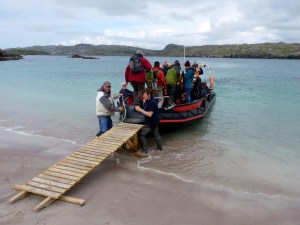
Handa Island is the most magical and awe-inspiring place. We could have spent hours just watching the birds, admiring the rock formations or examining the flowers, but we had to catch a boat back or be stranded on the island overnight.
We think of the Scottish Highlands as being a wild, unspoilt, natural place, but in fact this is far from true. Most of the upland habitat has been changed by grazing, tree-planting and drainage, so that natural habitats are rare. More than half of the species found there are declining, some with a high risk of extinction.
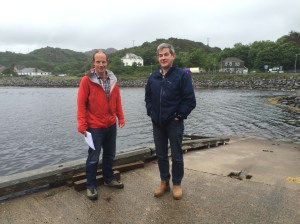
Richard Williams and Boyd Alexander from the Coigach-Assynt Living Landscape project.
Richard Williams and Boyd Alexander have a plan to turn this around. They are running one of the largest landscape restoration schemes in Europe, the Coigach-Assynt Living Landscape project. This long term project, led by the Scottish Wildlife Trust, aims to restore wildlife over 60,000 hectares of the Scottish Highlands.
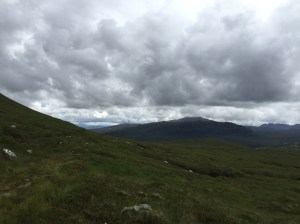
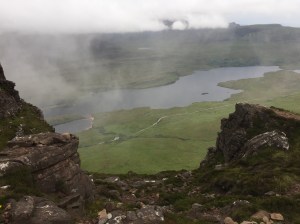
A blanket of cloud lies over Ben Mor Coigach, Scottish Wildlife Trust’s largest nature reserve, viewed here from Stac Pollaidh.
I joined them for lunch at the cafe next to their office at Lochinver, in the heart of the project area. Richard explained that the project involves seven major landowners and several local organisations. They have recently secured a Heritage Lottery Fund Landscape Partnership grant, and are just starting to build a team to deliver the work. Having fallen in love with Scotland, I daydreamed briefly about applying to join them, but no, for many reasons, it is not to be.
The CALL project will excavate and stabilise the collapsed Clachtoll Broch. This is a different Broch, at Dun Carloway on Lewis, but shows the double skinned construction of these mysterious Iron Age structures.
The project is an exciting mix of nature conservation, archeology, training and education. Woodland is an important element of the project; increasing the extent of native woodland will provide new habitat for many threatened species. The project also aims to work with schools to encourage them to use woodland as a classroom for outdoor learning. Working with landowners and local community groups, native woodland will be extended through changes in land management to allow natural regeneration, and by planting of native trees.
Nick Clooney at the Little Assynt Tree Nursery
How do you get enough native Scottish tree saplings to plant woodland on such an ambitious scale? Boyd took me to meet Nick Clooney at the Little Assynt Tree Nursery to find out. Nick collects native tree seeds from local woodlands. Some seed, like willow, needs to be planted straight away, whereas some needs a cold period before it can germinate. These are stored in layers of sand outside through the winter and then brought inside to be planted.
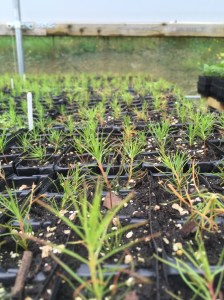
Most of the trees start growing here. The seeds germinate at different rates, so each seedling is removed once it is big enough to handle and grown on in cellular pots.
Pots of seedling Scots pine. This is the only native pine tree in Scotland. The seed is collected from an ancient Scots pine woodland near Ullapool.
Young trees ready for planting. About 15 native species are grown here, including rowan, hazel, wych elm, birch and three kinds of willow.
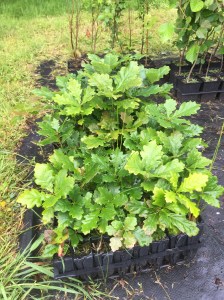
There is a big demand for oak trees, it is one of the species the Forestry Commission stipulates for native planting. This was the last tray of a recent batch of oak seedlings.
Another resident of the polytunnel! We spotted this common toad amongst the seedbeds.
Some seeds, such as hazel, need to be planted in vole-proof seed beds
Red deer are an iconic part of the Highland landscape but are also one of the main reasons for the lack of trees. Grazing animals such as sheep and deer nibble away any tree seedlings before they have a chance to grow.
The trees are sold to landowners who want to create native woodland on their land. They can apply for grant funding to help with the cost of creating and managing new woodland, including putting up extensive deer fencing, needed to exclude deer while the young trees get established.
The Coigach-Assynt Living Landscape is such an exciting project, encompassing stunning habitats from mountain to coast, with fascinating wildlife and a rich cultural heritage. I can’t wait to come back and explore more of the area and see how the project is getting on.