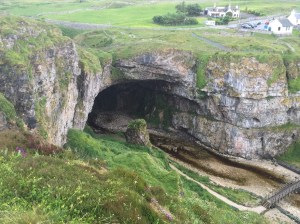
Smoo Cave, who knows what could be lurking in the dark depths?
Our wildlife tour had taken us right up to page 107 of my Road Atlas of Britain, along the Kyle of Durness and into the awe-inspiring Smoo Cave on the north coast of Scotland. After slowly heading south over a few weeks, we suddenly jumped to page 2, the far south-west of Britain, exploring Cornwall. What better place to search for damsels and dragons?
This male southern hawker dragonfly was flying along a woodland path at Gwaith Powdwr, a North Wales Wildlife Trust nature reserve.
In truth, spend any bright summer day near freshwater and you will soon be captivated by the jewel-bright flashes of damselflies and dragonflies as they dart across ponds and lakes, or skim along rivers and streams. You don’t even need to be near water to see some species, we often saw hawker dragonflies as we walked along woodland paths. But the days we saw whole rainbow selections of damsels and dragons were those we spent in the West Country and North Wales. I’d like to attribute this to some mythical link, but actually I suspect we were just lucky with the weather.
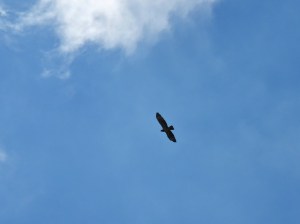
I stop to watch buzzards. There were several in the sky above Bissoe Valley.One of the large ponds at Bissoe Valley Nature Reserve.
Making the most of the warm Cornish sunshine, and feeling optimistically energetic, we set out from Devoran on the coast to coast cycle trail. After just a couple of miles I was excited to come across a Cornwall Wildlife Trust reserve sign. Hastily abandoning my bike, I went to investigate Bissoe Valley nature reserve. Noticing my absence after a while (it’s not unusual for me to be lagging a bit behind, I stop to look at things and probably don’t make a very good cycling companion) Geoff cycled back to the reserve, picked up my bike and parked it properly, and came to see what the distraction was this time. Just as well he did, as he took some fantastic photographs. All the images in this post are his, please credit Geoff Woolley if you want to use any.
This common darter dragonfly was very obliging for the camera.
male common darter dragonfly
male common darter dragonfly
striking a pose
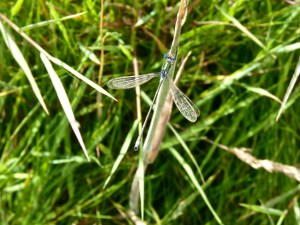
Metallic green emerald damselflies with sapphire eyes shimmered across the pools. It is easiest to photograph them when they are “in tandem”, the male clasping the female behind her head. This is part of the mating process, the female will curl her tail round (technically, her abdomen) to the male so that sperm can be transferred.
Male emerald damselfly
Female and male emerald damselfly
Male and female emerald damsel-flies (these ones from Gwaith Powdwr)
We saw several other species, but unless they stayed still for a few moments it was impossible to photograph them. You will just have to visit a reserve to see for yourself – it’s not too late, you should see them on any warm day over the next few weeks. Meanwhile, here are a few more from our travels.
We saw golden-ringed dragonflies but didn’t manage to catch one at rest until this gorgeous one at Dartmoor
Keeled skimmer dragonfly
This female common darter dragonfly seems to be inspecting us as much as we are admiring her.
Mystery female dragonfly, the only one I couldn’t identify, seen at Gwaith Powdwr – any suggestions?
This common hawker dragonfly at Gwaith Powdwr had recently emerged from its larval skin.
Blue-tailed damselfly mirrored in a pool at East Chevington nature reserve, Northumberland.
Keen to try out another top UK wildlife experience, we headed to Cemlyn Bay, a North Wales Wildlife Trust reserve, seeking out one of the UK’s largest nesting tern colonies. Wear a hat for terns, the Wildlife Trusts’ website suggests, as terns are very protective of their nests and will dive bomb suspected intruders. No hats were needed, however, as the terns had just finished a busy summer of raising chicks, and most of the birds had dispersed.
Even one tern is worth watching though, and we stood spellbound on the beach as the few terns that were left wheeled and turned effortlessly, their finely pointed wings slicing through the air. Every now and then they paused to hover before folding back their wings and plunging into the water.
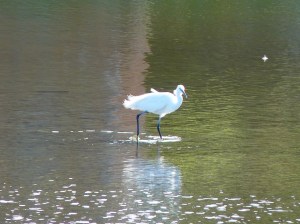
There were still plenty of birds to see on the islands in the lagoon that lies behind the long shingle spit, including a few more terns, oyster catchers and ringed plovers. A heron stood like a statue in the shallow water whilst a little egret stalked through the water. On the way round the circular walk that we explored, we saw a heron, possibly the same one, flying low over a field with long slow beats of its huge wings. The hedgerows were glowing with red campion, which seemed to grow more thickly along Anglesey lanes than anywhere else, intermingled with the softer purples of black knapweed and devilsbit scabious.
A grey heron flies low over the farmland behind the reserve.
Little egret
I think this was a young stonechat sillouetted against the sky but am happy to be corrected by more experienced birders!
The long curve of the shingle ridge, Esgair Gemlyn, lies between the sea and a shallow lagoon
Shingle at Cemlyn Bay
Behind the lagoon at Cemlyn Bay
Small white butterfly on devilsbit scabious
Red campion in the hedgerows
Another place to add to my list of reserves to revisit then, but next time I’ll come a little earlier in the summer.
I was struck by how many of the sites I’ve visited during this trip have been reclaimed from industry. Of course most Wildlife Trust nature reserves are habitats that have taken hundreds of years to establish and are now saved for the future, but something the Trusts are very good at is bringing wildlife back to areas that have been used for quite different purposes.
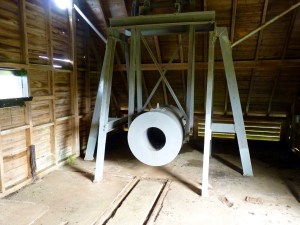
The Pendlum Shed houses a huge ballistic pendulum, used to grade the quality of the explosives produced on site. A canon, set with a charge of explosive was pushed into the hole in the pendulum and fired. The distance it swung would be used to calibrate the strength of the explosive. The heath around this area is now the main nesting site for nightjars.
Gwaith Powdwr, at Penrhyndeudraeth, is one such site. In the 1970s it was the most sophisticated nitroglycerin manufacturing plant of its kind in the world. Production stopped in 1995, and it was decontaminated before being donated by ICI to North Wales Wildlife Trust, Ymddiriedolaeth Natur Gogledd Cymru, in 1998.
Heathland at the top of the site, overlooking the Dwyryd estuary
Due to the security requirements of the site, nature survived undisturbed in parts of the site, the heathland in particular has remained mostly ungrazed and is a haven for species such as adder and nightjar.
Wildlife started to reclaim the rest of the site once the factory was closed, bats moved into the buildings and structures and the site is now designated as a Site of Special Scientific Interest because of its importance for bats, especially the rare lesser horseshoe bat.
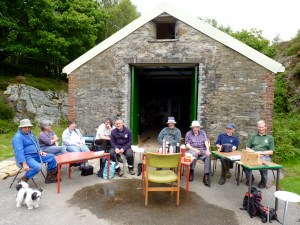
The volunteers meet regularly on Wednesdays to help manage the site. Today they were clearing paths, making space for visitors and making bat boxes in preparation for Party Penrhyn.
At the end of July, we joined Rob Booth, Living Landscapes Officer at NWWT, and his volunteers for their lunch break. They were busy getting ready for Party Penrhyn, an annual event at the site. Rob told us about the wildlife on the reserve and the work that is being done to encourage more wildlife.
Female slow worm
The reserve provides ideal conditions for four kinds of reptiles. We saw lizards basking on old wood and bare patches of ground amongst the heather, and were given permission to peak under some reptile monitoring sheets, where bronze-sheened slow worms glinted in the sun before slipping further into the thatch of grass and old bracken. Adders are also to be found in the heathy parts of the site, but sadly not by us, although we searched carefully. In the midday heat they are far too quick for mere humans and would have been off as soon as they heard us coming. (Although snakes don’t appear to have ears, they can in fact hear, by sensing vibrations, including sound waves, which are passed through their jaw to an inner ear.)
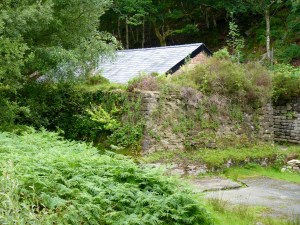
This storage shed has been re-roofed for bats. Many of the buildings are protected by blast walls. One of the volunteers had been researching the history of the site and told us about two serious explosions that had happened in the previous century.
As the reserve is so important for bats, much of the management is aimed at improving conditions for them. Lesser horseshoe bats use the tunnels and there are up to 30 hibernating on site but they don’t seem to breed there. The Trust managed to get a grant to re-roof one of the explosive storage sheds, and are hoping it will become a maternity roost. Since the work was done, brown long-eared bats have bred in there and Rob said that lesser horseshoe bats are already checking it out. The Trust is also working to make the bunkers more homely for bats, putting new doors on to prevent disturbance, reduce light levels and draughts and make them safer from predators.
The woodland on the reserve is particularly good for moths, the Trust found 130 species in just one night. Where a stream runs through the woodland, the damp, shady conditions are ideal for ferns and mosses.
Clouded border moth
Woodland at Gwaith Powdwr
Speckled wood butterfly
Ferns and moss in the damp woodland
Ponds were part of the industrial legacy, providing water to help keep the explosives cool (and therefore stable) and also allowing contaminants to settle out of the water. These settling ponds are now a wildlife haven, we saw lots of tiny toadlets setting off on their journey into the big world of dry land, stragglers from the great toadlet exodus that happens during July. The grass snakes that have been seen around the ponds proved elusive, which is probably fortunate for the toadlets. Dragonflies and damselflies darted across the water, rarely settling long enough to have their photographs taken, except by the most patient of photographers. Fortunately I had one with me.
White water-lilies
Toadlet coming up for air
Male and female emerald damsel-flies (these ones from Gwaith Powdwr)
This male southern hawker dragonfly was flying along a woodland path at Gwaith Powdwr, a North Wales Wildlife Trust nature reserve.
Settling pond at Gwaith Powdwr
This common hawker dragonfly at Gwaith Powdwr had recently emerged from its larval skin.
We had such a brilliant time exploring Gwaith Powdwr, everywhere we looked there was interesting wildlife. It is a fantastic example of how a site can be restored after such intense industrial use.















 The only way is wildlife