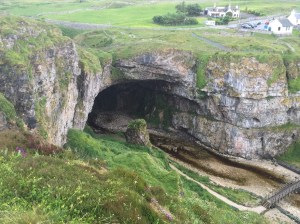
Smoo Cave, who knows what could be lurking in the dark depths?
Our wildlife tour had taken us right up to page 107 of my Road Atlas of Britain, along the Kyle of Durness and into the awe-inspiring Smoo Cave on the north coast of Scotland. After slowly heading south over a few weeks, we suddenly jumped to page 2, the far south-west of Britain, exploring Cornwall. What better place to search for damsels and dragons?
This male southern hawker dragonfly was flying along a woodland path at Gwaith Powdwr, a North Wales Wildlife Trust nature reserve.
In truth, spend any bright summer day near freshwater and you will soon be captivated by the jewel-bright flashes of damselflies and dragonflies as they dart across ponds and lakes, or skim along rivers and streams. You don’t even need to be near water to see some species, we often saw hawker dragonflies as we walked along woodland paths. But the days we saw whole rainbow selections of damsels and dragons were those we spent in the West Country and North Wales. I’d like to attribute this to some mythical link, but actually I suspect we were just lucky with the weather.
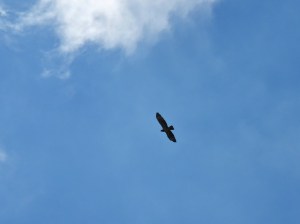
I stop to watch buzzards. There were several in the sky above Bissoe Valley.One of the large ponds at Bissoe Valley Nature Reserve.
Making the most of the warm Cornish sunshine, and feeling optimistically energetic, we set out from Devoran on the coast to coast cycle trail. After just a couple of miles I was excited to come across a Cornwall Wildlife Trust reserve sign. Hastily abandoning my bike, I went to investigate Bissoe Valley nature reserve. Noticing my absence after a while (it’s not unusual for me to be lagging a bit behind, I stop to look at things and probably don’t make a very good cycling companion) Geoff cycled back to the reserve, picked up my bike and parked it properly, and came to see what the distraction was this time. Just as well he did, as he took some fantastic photographs. All the images in this post are his, please credit Geoff Woolley if you want to use any.
This common darter dragonfly was very obliging for the camera.
male common darter dragonfly
male common darter dragonfly
striking a pose
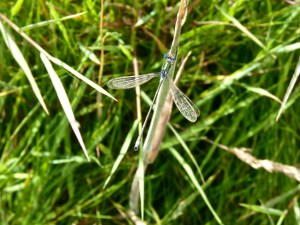
Metallic green emerald damselflies with sapphire eyes shimmered across the pools. It is easiest to photograph them when they are “in tandem”, the male clasping the female behind her head. This is part of the mating process, the female will curl her tail round (technically, her abdomen) to the male so that sperm can be transferred.
Male emerald damselfly
Female and male emerald damselfly
Male and female emerald damsel-flies (these ones from Gwaith Powdwr)
We saw several other species, but unless they stayed still for a few moments it was impossible to photograph them. You will just have to visit a reserve to see for yourself – it’s not too late, you should see them on any warm day over the next few weeks. Meanwhile, here are a few more from our travels.
We saw golden-ringed dragonflies but didn’t manage to catch one at rest until this gorgeous one at Dartmoor
Keeled skimmer dragonfly
This female common darter dragonfly seems to be inspecting us as much as we are admiring her.
Mystery female dragonfly, the only one I couldn’t identify, seen at Gwaith Powdwr – any suggestions?
This common hawker dragonfly at Gwaith Powdwr had recently emerged from its larval skin.
Blue-tailed damselfly mirrored in a pool at East Chevington nature reserve, Northumberland.
The dunes of the Northumberland coast are like no others, driven by the strong sea winds into tall, narrow mounds of sand and constantly changing. “This could look different tomorrow” Steve Lowe, from Northumberland Wildlife Trust told me as we stood beside the dune system along the seven mile stretch of sand that forms Druridge Bay.
Coal fragments make patterns in the water where the waves lap the shores of Druridge Bay
Druridge Bay has been shaped by change – the elements, nature and human activity all play a part in creating this fascinating area. Humans have been driving that change for more than 5,000 years. Human footprints found in post-glacial deposits and other evidence, much of it uncovered in a recent archaeological project in which the Trust were partners, date human occupation from the Mesolithic period.
Over time, people changed the landscape from wilderness to farmland. Then the increasing need for coal led to the creation of an industrial landscape with underground and open cast mining. Ironically, this has eventually led to the creation of new wildlife habitat, formed by the subsidence of old mining areas, and restoration of open cast mines.
A flowery grass path leads into East Chevington Nature Reserve.Wetland birds at East Chevington nature reserve. The grass is full of foraging lapwings.
Steve was showing us round some of the five Northumberland Wildlife Trust reserves that form the core area of the Dynamic Druridge project, which aims to continue the theme of change, restoring, recreating and reconnecting habitats and improving people’s access to the wildlife of the area.
East Chevington nature reserve was restored to create wetland habitats after opencast mining and passed to the Trust in 2003. In their care it has become one of the best birdwatching sites in Northumberland, with huge numbers of birds using the lakes and especially in autumn and winter. A newly planted woodland area provides an ideal place to run Forest Schools, where children can develop confidence through outdoor activities.
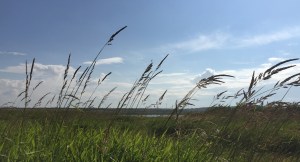
The reedbeds that fringe the lake provide nesting sites for reed bunting and reed warbler, and have attracted the first marsh harriers to breed in Northumberland for 130 years.
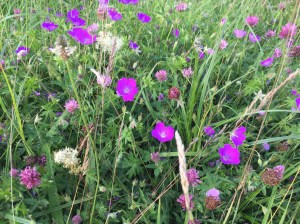
Bloody cranesbill (Geranium sanguineum) is common locally, growing here in wet grassland with meadowsweet and red clover
Dragonflies and damselflies zipped across the water. I like the way this blue-tailed damselfly (Ischnura elegans) is reflected in the water in Geoff’s photo.
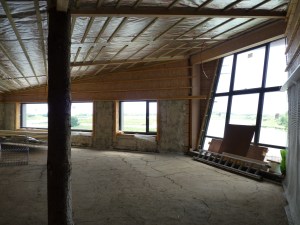
Steve took us to the Hauxley reserve next, which is temporarily closed while Northumberland Wildlife Trust constructs the greenest building in the North East. As well as being very environmentally friendly, the amazing thing about this building is that it is being built by volunteers.
The Trust secured a Heritage Lottery Fund grant to replace the previous visitor centre, which had been burnt down, with an iconic sustainable building. The project employs a site manager and the Trust staff manage the project but most of the work is done by volunteers. There was a huge sense of camaraderie among the volunteers and the work that has already been achieved was inspiring.
Duncan Hutt explains how the building is designed to minimise its impact on the environment. Green roofs provide wildlife habitat as well as insulation against heat and cold, and reduce the risk of surface water flooding around the building.
I donned a hard hat and high-vis so that I could go on site, and Ducan Hutt, Head of Estates management at the Trust, showed me around the building. It is designed to minimise its impact on the environment. No concrete is used in the construction, the walls are straw bales rendered with a lime based plaster, timber is obtained locally, much of it from Northumberland Wildlife Trust’s own reserves.
The work requires some rather special skills. The building is a straw bale construction, which as well as being environmentally friendly is usually easy to build. In this case the iconic angular design meant that new construction techniques had to be developed.
Some of the walls are built with gabions which, as Duncan said, are basically dry stone walls in a cage. You need a good eye to pick just the right shaped stone to fill a gap to ensure that the finished wall is weatherproof.
I tried to imagine the huge amount of work that went into building the packed earth floor. Volunteers mixed clay, sand and straw and the brought it in by the barrowload, spreading and compacting to form a smooth, hardwearing surface.
I’m immensely grateful to Steve and Duncan for taking the time to show me what the Dynamic Druridge project is achieving and am already looking forward to coming back to see the completed visitor centre and the rest of the reserves in this beautiful area.
A huge window looks across the surrounding landscape
Steve Lowe and Duncan Hutt
Bloody cranesbill, Northumberland’s county flower
The Lake at East Chevington Reserve
Seven miles of sandy beach
Edited 25.8.16 to correct an embarrassing mis-spelling of Druridge.








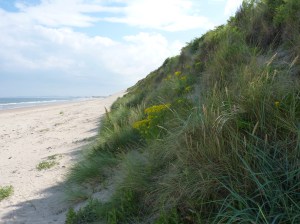 The dunes of the Northumberland coast are like no others, driven by the strong sea winds into tall, narrow mounds of sand and constantly changing. “This could look different tomorrow” Steve Lowe, from






 The only way is wildlife