Bass Rock, off the Scottish coast. The entire rock is white with gannets at this time of year.
Clouds of gannets rise up from Bass Rock and fill the air with raucous cries, slicing effortlessly through the air on snow-white, black-dipped wings.
We bounced on top of the water beneath them, heads tipped back to gaze in awe at the graceful circus of gannets above our heads, holding on tight as the RIB (Rigid Inflateable Boat) met the waves with rather less grace.
Although they nest in dense colonies, gannets are highly territorial, each making it loudly clear to its neighbour that this is my patch. Gannets return to the same patch each year form long-term pairs, often for life. Bill fencing is a form of greeting behaviour that strengthens the bond between pairs.
The dagger-like bill of the northern gannet is used to catch fish. The gannet folds back its wings and plunges vertically from a height of up to 40 metres, disappearing under the water to capture its target.
The gannet colony has increased hugely since the lighthouse has been unmanned so that the island is now uninhabited.
Shags breed on the nearby rocks. In the breeding season they develop an iridescent green sheen to their feathers and a spiky quiff, giving them a somewhat surprised look.
Gannets breed in tightly packed colonies, despite being highly territorial.
Swirling clouds of gannets
Cormorants on a nearby island. They don’t have as much oil on their feathers as other seabirds, and have to stretch them out to dry off from time to time.
This is the closest we’ve got to guillemot. They breed on a nearby island.
The snowy white plumage and creamy yellow head of the gannet is unmistakeable.
As a wildlife experience, this was one of the best, plus being fun going out in the boat. Can’t wait to do it again next time I’m in Scotland.
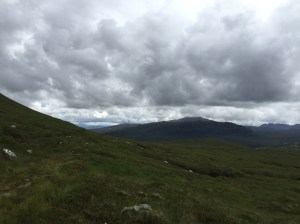
We think of the Scottish Highlands as being a wild, unspoilt, natural place, but in fact this is far from true. Most of the upland habitat has been changed by grazing, tree-planting and drainage, so that natural habitats are rare. More than half of the species found there are declining, some with a high risk of extinction.
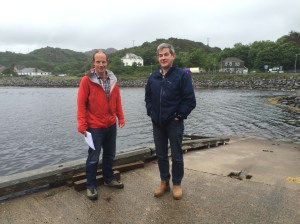
Richard Williams and Boyd Alexander from the Coigach-Assynt Living Landscape project.
Richard Williams and Boyd Alexander have a plan to turn this around. They are running one of the largest landscape restoration schemes in Europe, the Coigach-Assynt Living Landscape project. This long term project, led by the Scottish Wildlife Trust, aims to restore wildlife over 60,000 hectares of the Scottish Highlands.
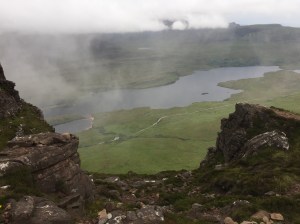
A blanket of cloud lies over Ben Mor Coigach, Scottish Wildlife Trust’s largest nature reserve, viewed here from Stac Pollaidh.
I joined them for lunch at the cafe next to their office at Lochinver, in the heart of the project area. Richard explained that the project involves seven major landowners and several local organisations. They have recently secured a Heritage Lottery Fund Landscape Partnership grant, and are just starting to build a team to deliver the work. Having fallen in love with Scotland, I daydreamed briefly about applying to join them, but no, for many reasons, it is not to be.
The CALL project will excavate and stabilise the collapsed Clachtoll Broch. This is a different Broch, at Dun Carloway on Lewis, but shows the double skinned construction of these mysterious Iron Age structures.
The project is an exciting mix of nature conservation, archeology, training and education. Woodland is an important element of the project; increasing the extent of native woodland will provide new habitat for many threatened species. The project also aims to work with schools to encourage them to use woodland as a classroom for outdoor learning. Working with landowners and local community groups, native woodland will be extended through changes in land management to allow natural regeneration, and by planting of native trees.
Nick Clooney at the Little Assynt Tree Nursery
How do you get enough native Scottish tree saplings to plant woodland on such an ambitious scale? Boyd took me to meet Nick Clooney at the Little Assynt Tree Nursery to find out. Nick collects native tree seeds from local woodlands. Some seed, like willow, needs to be planted straight away, whereas some needs a cold period before it can germinate. These are stored in layers of sand outside through the winter and then brought inside to be planted.
Most of the trees start growing here. The seeds germinate at different rates, so each seedling is removed once it is big enough to handle and grown on in cellular pots.
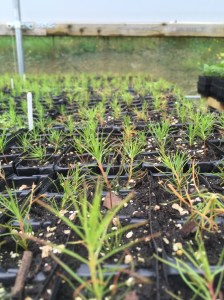
Pots of seedling Scots pine. This is the only native pine tree in Scotland. The seed is collected from an ancient Scots pine woodland near Ullapool.
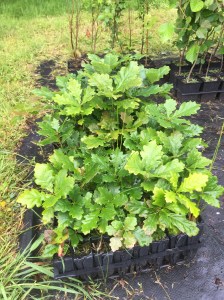
Young trees ready for planting. About 15 native species are grown here, including rowan, hazel, wych elm, birch and three kinds of willow.
There is a big demand for oak trees, it is one of the species the Forestry Commission stipulates for native planting. This was the last tray of a recent batch of oak seedlings.
Another resident of the polytunnel! We spotted this common toad amongst the seedbeds.
Some seeds, such as hazel, need to be planted in vole-proof seed beds
Red deer are an iconic part of the Highland landscape but are also one of the main reasons for the lack of trees. Grazing animals such as sheep and deer nibble away any tree seedlings before they have a chance to grow.
The trees are sold to landowners who want to create native woodland on their land. They can apply for grant funding to help with the cost of creating and managing new woodland, including putting up extensive deer fencing, needed to exclude deer while the young trees get established.
The Coigach-Assynt Living Landscape is such an exciting project, encompassing stunning habitats from mountain to coast, with fascinating wildlife and a rich cultural heritage. I can’t wait to come back and explore more of the area and see how the project is getting on.







 The only way is wildlife